Gymsurance
- A Gym That Pays for Itself Through Health Insurance Savings
- Who Goes to Gyms?
- The Annual Health Check Conundrum
- Learning from Past Innovations
- Why Gymsurance could work
- 1. A Virtuous Cycle of Health & Savings
- 2. Key Differentiators
- The Business Model
- Revenue Streams
- How Gyms Benefit from Health Monitoring Partnerships
- Market Viability
- Target Audience
- Tech Dependencies & Future Trends
- Current Tech Stack
- Perfect Timing
A Gym That Pays for Itself Through Health Insurance Savings
Imagine a gym membership that doesn’t cost you anything-provided you stay active and maintain good health.
This idea integrates health insurance with fitness tracking, allowing members to earn discounts or even fully subsidized memberships based on their activity levels and health metrics.
Additionally, gyms can bundle health monitoring services-through our partnerships with health check-up providers-creating a win-win model for members, gyms, and insurers alike.
The idea is not
- Build an insurtech startup
- Build an insurance provider
- Start a gym
- Start a health checkup / lab
- Become a GP
- Be a fitness instructor
The idea is
- Build the layer in-between that enables any gym to offer a truly luxury connected experience right after signing on with differentiated benefits for all members that sign up to specific plans
Who Goes to Gyms?
Gyms typically attract these categories of people:
- Health Improvers: People whose health isn’t optimal but are committed to improving it
- Fitness Seekers: People with decent health but looking to enhance their fitness levels
- Weight Loss Seekers – People specifically looking to lose weight, often driven by health concerns or personal goals.
- Fitness Maintainers: People who are already fit and want to maintain or further improve their condition
- Athletes & Performance Trainers – Individuals training for sports, bodybuilding, or other athletic goals requiring specialized training.
- Casual Gym-Goers – Those who occasionally exercise but lack a consistent routine. They might be motivated by seasonal goals (e.g., getting in shape for summer).
- Social Exercisers – People who go to the gym for the community aspect, group workouts, or networking rather than just fitness.
- Rehabilitation & Recovery Users – People recovering from injuries or medical conditions who use gyms for guided rehabilitation.
- Senior Fitness Enthusiasts – Older adults focused on mobility, flexibility, and overall health maintenance.
Categories 1 to 5 represents excellent candidates for health insurance since they’re actively reducing health risks through their commitment to fitness, but, they will end up paying a similar amount in insurance as the people in categories 5-8.
However, the traditional gym model excludes those who cannot afford membership fees or struggle to prioritize fitness financially or generally - like the casual gym goer.
The Annual Health Check Conundrum
Health check-ups are essentially mandatory on a yearly basis for people above the age of 30. Despite being relatively affordable, a random sampling of people you know would reveal that very few actually adhere to this recommendation. Why? Because it’s perceived as an added expense with minimal immediate value.
Learning from Past Innovations
Last year, I observed a promotion where an insurance provider partnered with an InsurTech company to offer subsidized insurance for Apple Watch users who walked 15km daily - https://www.instagram.com/accord.apple.store/p/DCyiIISt5ZW/
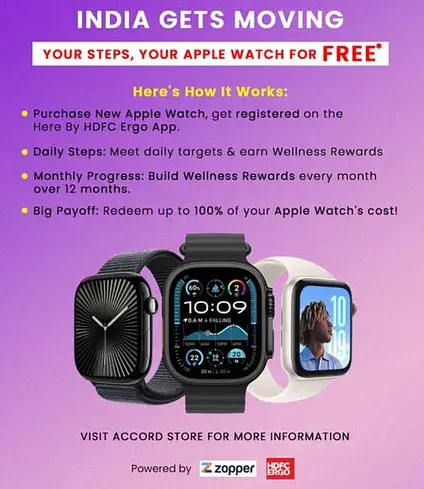
And while it has played out badly for everyone involved, I still thought it was interested
An insurance provider, tied up with an InsurTech company to provide a subsidized insurance product under the assumption that people who bought apple watches and walked 15km everyday were going to be healthy.
Now, there are multiple loopholes in the monitoring of this and it’ll play out how it plays out, but, the fundamental concept and the fact that an insurer was interested in it has stayed with me.
Why Gymsurance could work
1. A Virtuous Cycle of Health & Savings
- Members stay active → Health improves → Insurance claims decrease → Insurers save money → Savings fund gym memberships.
- By integrating health check-ups at discounted rates, gyms attract more members while insurers gain better predictive health data.
2. Key Differentiators
- Integration of health insurance with fitness tracking: Unlike traditional gyms, this model ties workouts to financial benefits.
- Bundled health monitoring services: Gyms offer discounted health check-ups, increasing their clientele.
- Real-time health monitoring: Wearable integration ensures continuous tracking of health metrics and Smart health test analysis through the health check up tie-ups
- Dynamic insurance pricing: Active members get lower premiums based on improved risk profiles which increases the Potential for a free gym membership since the membership could pay for the insurance itself
The Business Model
Revenue Streams
- Insurance Partnerships – A percentage of the insurer’s savings from reduced claims is redirected to fund memberships.
- Membership Fees – Users pay a base fee that reduces with increased activity. Highly active members could qualify for free membership.
- Bundled Health Check-ups – Gyms offer discounted health monitoring as a value-add, increasing member retention and revenue.
- Premium Services – Personal training, health coaching, and specialized programs based on monitored data - Any gym can offer a higher quality of service and introduce specialized programs through a more extensive data set.
How Gyms Benefit from Health Monitoring Partnerships
- Higher member retention – Members stay longer if they get regular health insights.
- Increased footfall – People who come in for check-ups may convert into gym members.
- New revenue streams – Offering bundled health check-ups differentiates the gym from competitors.
- Stronger insurer partnerships – More data means better risk models, increasing insurer investment in gym partnerships.
Market Viability
Target Audience
- Health-conscious professionals – People already investing in fitness and insurance.
- Corporate Employees – Companies looking for wellness solutions to reduce healthcare costs.
- They are the biggest source of group insurance policies for insurance providers, but, these are heavily discounted policies which more often than not do not provide enough coverage.
- Urban Middle-Class – Individuals with growing health awareness and disposable income.
- Considering the diabetes epidemic and in general wellness crisis looming over India this could have added benefits.
Tech Dependencies & Future Trends
Current Tech Stack
- Wearable integration platform (Apple Health, Fitbit, Garmin, etc)
- Health metrics tracking system (Steps, heart rate, sleep, calories burned)
- Insurance premium calculation algorithms (AI-powered risk modeling)
- Real-time monitoring dashboard
- HIPAA-compliant data storage
- Automated reporting system for insurers & gyms
- Automated health test reports scanning and viz and more advanced analysis based on blood test reports
🏋️ Gyms get more members and new revenue streams.
💰 Members get access to affordable health check-ups and free memberships.
🏥 Insurers benefit from healthier customers and reduced claims.
Perfect Timing
With a growing focus on preventive healthcare, rising insurance costs, and increasing wearable adoption, the timing is perfect for an integrated gym-insurance model.
Would you pay for a gym membership if it could become free? Would insurers invest in your fitness if they saw real savings? I think these are questions worth answering
I would love to know what you think and if you or someone you know wants to discuss this in more detail, please hit me up!
Sainath